When client onboarding takes longer than the actual bookkeeping work, something's broken.
The situation
A bookkeeping practice in Melbourne with three staff members was growing steadily. New clients were coming in, which should have been great news. Instead, it was creating chaos.
Every new client meant the same exhausting routine: collecting business details via email, chasing missing documents, manually creating folders in their file system, setting up the client in Xero, adding them to their practice management software, and sending welcome emails with login instructions.
The practice owner estimated each new client took around 2.5 hours of administrative work before any actual bookkeeping could begin. With six to eight new clients per month, that's 15 to 20 hours spent on repetitive data entry and follow-ups.
Worse, things fell through the cracks. A staff member would forget to add a client to the practice management system. Documents would sit in an inbox for days. Welcome emails went out with the wrong information because someone copied from an old template and missed a detail.
The real cost
Beyond the hours lost, there was a harder-to-measure cost: the practice owner was spending her evenings catching up on actual client work because her days were consumed by administration. Her team was frustrated, clients sometimes waited longer than expected to get started, and the business couldn't grow beyond what they could manually handle.
The practice had good systems individually. Xero for accounting, Karbon for practice management, Google Drive for documents, and Gmail for communication. But nothing talked to each other. Every piece of client information had to be typed in multiple times, and there was no single view of where a new client was in the onboarding process.
What we built
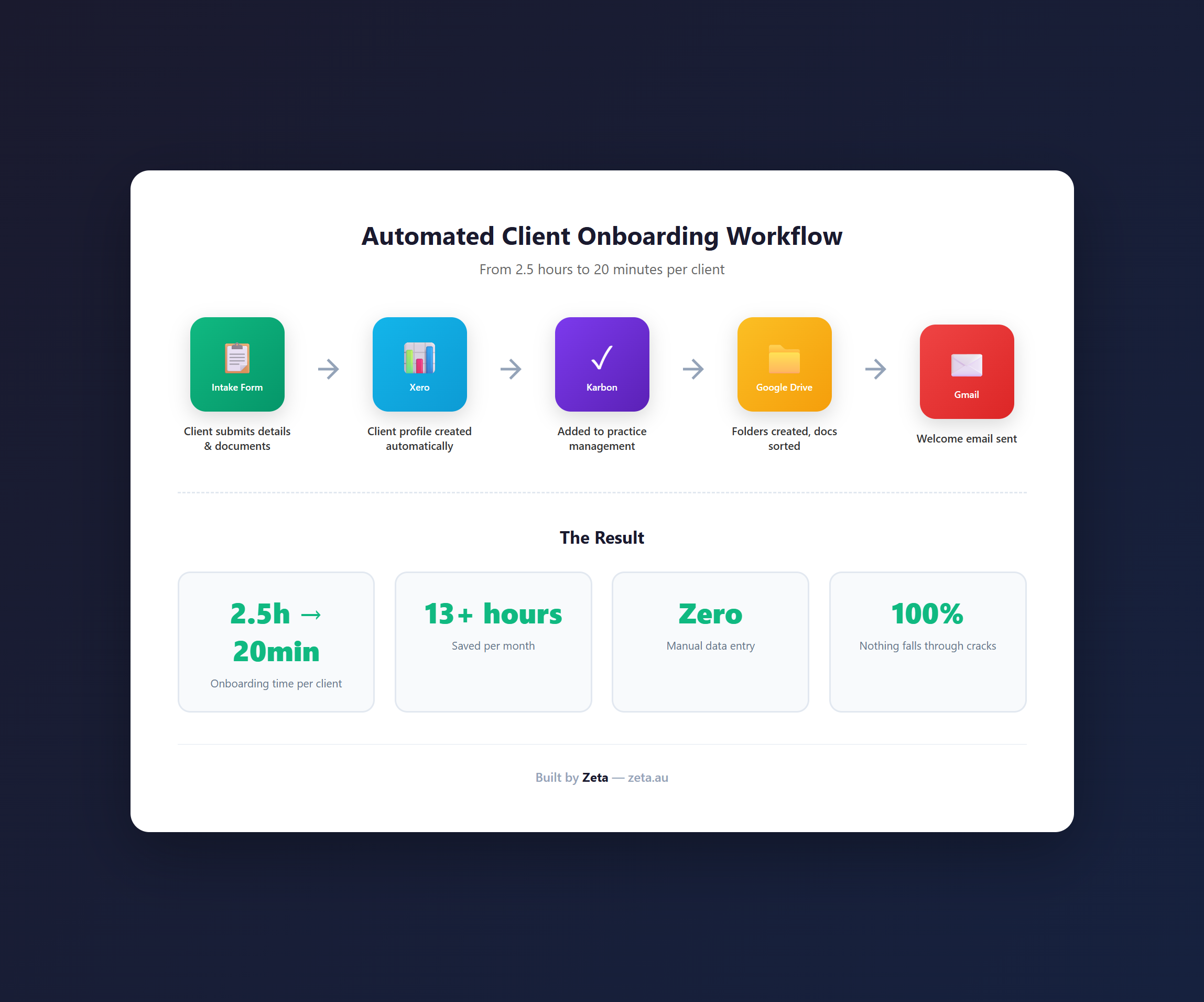
We created an automated client onboarding workflow that connected their existing tools and eliminated the manual handoffs.
A proper intake form replaced email back-and-forth. New clients complete a single online form that collects everything upfront: ABN, business structure, contact details, accounting software access, and document uploads. Validation ensures nothing critical gets missed.
Automatic client setup across all systems. When a form is submitted, the workflow creates the client record in Karbon, sets up the appropriate folder structure in Google Drive, and prepares the Xero client profile. No more logging into three different systems to enter the same details.
Document handling without the chasing. Uploaded documents are automatically sorted into the correct folders. If required documents are missing, the system sends a polite follow-up request without anyone having to remember to check.
Personalised welcome emails that actually work. Each new client receives a welcome email with their specific login details, next steps, and assigned team member contact. Generated automatically, reviewed by staff if needed, then sent.
A single dashboard showing onboarding status. The practice owner can now see exactly where every new client sits in the process. No more wondering if someone's been set up or checking three different systems to piece together the picture.
The outcome
The onboarding time dropped from 2.5 hours per client to around 20 minutes of human oversight. Most of that remaining time is a quick review to make sure everything looks right before the welcome email goes out.
Over a month with six new clients, that's roughly 13 hours reclaimed. Time the team now spends on billable work and client relationships rather than copy-pasting between systems.
But the numbers only tell part of the story. The practice owner mentioned that she no longer dreads new client enquiries. Growth feels manageable now, not overwhelming. Her team is less frustrated, and clients get started faster with fewer back-and-forth emails.
Could this work for your practice?
If you're running a bookkeeping, accounting, or financial planning practice, the pattern is often similar: good individual tools that don't connect, manual processes that eat into productive time, and a sense that growth will only make the problem worse.
The specific tools vary. You might use MYOB instead of Xero, or FYI instead of Karbon. The approach adapts to whatever you're already using.
The question worth asking: how much of your team's time goes into work that a system could handle? And what would you do with that time back?
Zeta helps Australian professional services firms connect their systems and automate the work that shouldn't need a human. If your practice is facing similar challenges, get in touch for a conversation about what's possible.